


What is a nestainer?
In a high-turnover warehouse, storage capacity is rarely limited by floor area alone. Fixed pallet racking locks the layout in place and needs installation and floor anchoring before the first pallet moves. Stacking goods directly on the floor avoids that cost but buries the pallet underneath, forces last-in-first-out retrieval, and leaves unstable loads exposed. Empty containers and returnable packaging then take up the same floor space as loaded ones, and the layout cannot respond when the product mix changes.
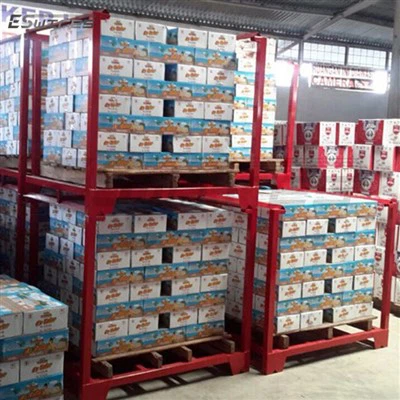
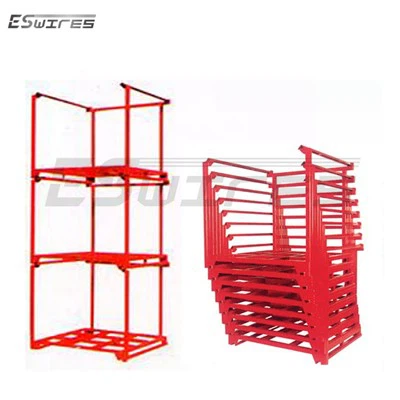
A nesting rack — often called a nestainer rack, and known in China as nestainer — addresses this with a simple steel structure: a welded frame on a steel pallet base, with posts that let identical units stack directly onto one another. Loaded units stack three to four high, so vertical space is used without touching the building structure. Because the units are freestanding and unanchored, they can be repositioned, added, or pulled out as inventory shifts, and in block storage no aisle is required between them. When empty, the frames nest inside one another — typically seven or eight units compress to the height of one — so return freight and idle storage stop consuming space.
Handling stays conventional: four-way forklift entry, standard pallet footprints, and no new equipment or operator training. Each level is rated for roughly 1,000 kg in standard configuration, with heavier ratings available through frame and deck reinforcement. That combination of familiar handling and flexible capacity makes nesting racks straightforward to slot into an existing operation — and easy to scale up one bay at a time.




Products Description
| products |
 |
 |
| Model number | Standard (deck at bottom) | Inverted (deck at top) |
| Storage positions per unit | 1 — one pallet per unit | 2 — the floor counts as level 1 |
| Move while loaded | Yes — forklift lifts the whole loaded unit, goods never touch the floor | No — the unit is a frame; goods are placed on the floor or on the deck first |
| Cost per stored pallet | Higher — one unit per position | Lower — about one third fewer units |
| Handling at floor level | Forklift only | Level 1 can be loaded by hand pallet truck |
| Stability under load | Load sits directly on the deck; low centre of gravity | Load sits on posts and deck; higher centre of gravity — needs correct tier count |
| Layout flexibility | High — reposition a loaded unit in minutes | Medium — units must be unloaded before relocating |
| Best for | Cross-dock, line-side supply, mixed SKUs, rented buildings, frequent re-layout, goods that must never touch the floor | Full warehouses, low ceiling, dense reserve storage, cost-driven projects, high pallet counts per m² |
| Avoid when | Floor space is the binding constraint and goods can be floored | Goods must travel loaded, or strict FIFO is required |
| products |
 |
 |
| Type | Rail | Pin |
| How it engages | A top rail and a bottom rail slide over each other; the angle difference creates a controlled gap that seats tighter as load and vibration increase | Four pins drop into sockets on the unit below; location is fixed by pin position, not by a sliding surface |
| Alignment when stacking | Forgiving — the fork only has to line up with one rail, then it slides into place | Demanding — all four pins must land in their sockets at once; needs a spotter or very steady control |
| Lateral resistance / seismic | Strong — the rail pair locks horizontally and the gap acts as a cushion | Weaker — pin joints are the first to release under lateral shock; the manufacturer's own comparison rates them as easier to come apart |
| Operator skill needed | Low | Noticeably higher |
| Can the two be mixed | No | No — a pin cannot seat on a rail, and a rail cannot swallow a pin |
| Best for | High-seismic regions, high-turnover stacking, mixed operator skill, fleets that must stay interchangeable | Cost-driven projects, narrow bays, light-to-medium loads, low-seismic sites, fixed layouts |
Designs


Benefits

Built to Move: Storage That Follows the Work
Nothing in this rack is fixed to the floor. A forklift lifts the loaded unit — frame, pallet and goods together — and sets it down wherever the next task sits, so a pick face can be relocated between shifts without a fitter, a drill or a permit. When a line is rebalanced, a contract ends or a layout simply stops working, the storage moves with it instead of becoming sunk cost in concrete. In leased buildings that must be handed back in their original condition, that single difference frequently decides the project.

Nesting: The Volume Disappears When the Rack Is Empty
A nesting rack is not a folding box — it works the other way. Empty frames drop inside the one below, so seven or eight units compress into the height of a single rack. A block that occupied half an aisle while loaded shrinks to one footprint when idle, which means empty equipment stops competing with inventory for space. The same geometry cuts return freight on closed-loop lanes to roughly a fifth of what rigid racks cost to send back, and it lets a seasonal overflow floor be cleared in an afternoon.

Seasonal Capacity: Built for a Peak, Stored for the Rest of the Year
Retail peaks, harvests, promotional builds and contract wins arrive on a calendar, not on a lease. Because these units need no floor preparation and no fixed installation, a temporary block can be standing and loaded in a day, then removed in an hour when the volume passes. Off-season, the same units nest into a corner rather than sitting empty on paid floor space. Storage cost then follows actual volume instead of being fixed for twelve months — which is why the format keeps turning up in 3PL contracts and pop-up distribution.

The Triangular Wedge: Why the Stack Survives a Quake
At every joint the two rails meet at slightly different angles — 90° below, 82° above — leaving a thin triangular gap. Under shaking the upper rail rotates into the lower one, the wedge closes, and the joint tightens as the energy rises, so a four-tier block moves as one body instead of four. Nothing is anchored, so the whole block slides and sheds that energy at the floor. Fully welded frames mean no bolts to loosen, nothing to shear off, no fixing point to fail.
Application


Case Share

Step 1 Customer requirements
Step 2 Proposal & solution

Step 3
Confirm design

Step 4
Sample test
Quality Control


Why choose ESWIRES? Part of the HM GROUP Family.
ESWIRES is proud to be a subsidiary of HM GROUP, a leader in manufacturing material handling products for over 30 years.
Manufacturing You Can Rely On
With in-house production capabilities, we control the entire process from raw material to finished product. This ensures consistent quality, stable load performance, and reliable delivery for bulk orders.
Export Experience & Efficient Communication
We work with global clients and understand international requirements in packaging, loading, and product standards. Clear communication and fast response help reduce sourcing risks and improve project efficiency.
Flexible Customization For Different Industries
Flexible Customization For Different Industries
We understand that storage needs vary. ESWIRES provides tailored solutions in size, load capacity, structure, and surface finish to match industries such as warehousing, automotive, retail, recycling, and manufacturing.
Long-Term Cost Efficiency
Our products are designed for durability and repeated use, helping customers reduce replacement frequency, optimize storage space, and lower overall logistics costs.
Certificates and Testimonials
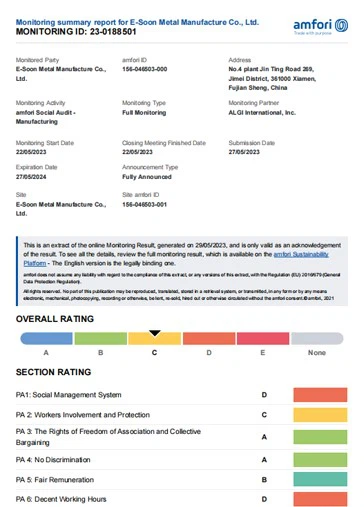
BSCI
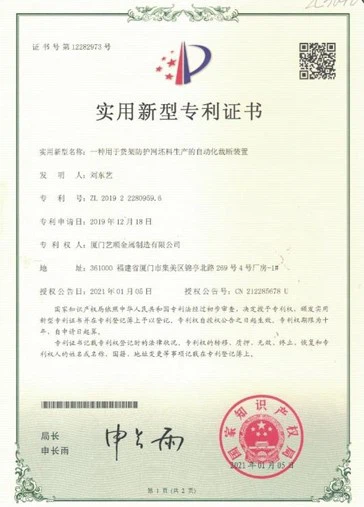
Certificate of Intellectual Property Rights

Customer Feedback

Customer Feedback
Products Description
Company Type And Payment Terms
Q: Are You A Trading Company Or Manufacturer?
ESWIRES is a company specializing in the production and trading of stacking racks. We are the manufacturer and deal directly with our customers.
Q: What Kind Of Payment Method Is Accepted? What Is The Payment Term?
We accept any convenient and prompt payment methods, such as: T/T, Western Union, Credit Card and L/C, etc.
Product Basics and Terminology
Q: What is a nesting rack, and what makes it different from a normal pallet?
A nesting rack — often called a stack rack, portable stacking rack, post pallet or stillage — is a steel frame with a load-bearing deck and four corner posts. Goods sit on the deck, the posts carry the units stacked above, and the empty frames nest into each other so a column of them collapses to roughly the height of one unit. A pallet only separates goods from the floor; a nesting rack adds a stacking structure and a protective frame around the load.
Q: What is the difference between a deck-at-bottom and a deck-at-top design?
With the deck at the bottom (upright), one unit gives one storage position, and a loaded rack can be moved by forklift as a single unit. With the deck at the top (inverted), the floor itself becomes the first storage level, so one unit gives two positions, but the rack can only be handled empty. The two designs solve different problems: transportability versus storage density.
Q: Rail-joint and pin-joint versions look similar — how do I choose?
A rail joint seats the upper unit's feet into a formed rail with a shallow V or channel profile; contact is continuous along the rail and the joint tightens under load. A pin joint drops the upper post onto a pin or into a socket; it locates the stack but resists lateral movement through the pin only. Rail joints are the better default for tall stacks and heavier loads; pin joints are simpler and usually cheaper, and are common on budget lines. The two types must never be mixed in the same stack — a pin will not seat in a rail, and a rail will not sit on a pin.
Load Capacity, Stacking and Safety
Q: Can I add up the capacity of each level?
No, and this is the most common specification error in the category. A rating of 1,000 kg per level does not mean a four-high stack holds 4,000 kg per unit. Each unit is rated for the load placed on it, and every unit's posts must carry everything above. In a four-high stack, the bottom unit supports three levels of load plus its own, so the posts — not the deck — set the limit. Always ask for the rated stack height that goes with the per-level figure.
Q: How many units can I stack?
It is a function of three things, not one: the per-level load rating, the height of the loaded unit, and the condition of the floor. Three and four high are the normal operating range in warehouses. Above that, the stack becomes a structure and needs its own check — post capacity, base bearing pressure and stability under lateral load. Do not treat the maximum stacking number in a catalogue as a universal permission.
Q: Does the capacity figure mean static load or working load?
Suppliers use both, and the difference matters. A static rating describes a load resting on the deck; a working or dynamic rating allows for forklift handling, shock and repeated use. Ask which figure is quoted and what safety factor sits behind it, and insist on the same basis when comparing two suppliers — otherwise a 1,200 kg "capacity" can be weaker than a 1,000 kg one.
Q: How does the rack behave in an earthquake?
The mechanism is worth understanding even without a test certificate. A rail joint forms a narrow wedge between the upper foot and the lower rail; as the stack sways, the wedge seats tighter rather than working loose, and a fully welded frame has no bolted connection to shake free. If the lateral force exceeds friction, the whole stack tends to slide as one mass instead of racking apart. That is a description of behaviour, not a certification — if seismic performance is a tender requirement, ask for the supplier's own test report and design calculation, and do not accept another brand's test data as evidence for your product.
Space, Handling and Day-to-Day Operation
Q: How much space does nesting actually save?
Typically a 7:1 to 8:1 reduction in the footprint of empty units, depending on the design. What nesting does not do is reduce height: a nested column is roughly as tall as a single unit, because each frame hangs on the one below. The saving is floor area and return-freight volume for empty equipment — not storage height, and not the footprint while the racks are loaded.
Q: Can a standard forklift handle a loaded rack?
Yes, if the rack is rated for it and the fork entry is clear. Bottom-entry models are picked up under the deck or through fork pockets; the forks must engage fully, and the load should be tilted back slightly and kept low while travelling. Check the rated load against the forklift's capacity at the actual lift height, not just its nominal capacity — capacity falls as the mast rises.
Q: Can I move a loaded rack across the warehouse?
Within the site, yes, at low speed and with the load lowered — that is the main operational advantage over fixed racking. It is not a transport container: for road or sea freight, loads should be secured or the goods repacked, and long-distance movement of loaded racks is not what the frame is designed for.
Q: Can they be used in a freezer or outdoors?
The steel itself is fine at low temperature; the finish and the floor are the constraints. Standard powder coating can become brittle and chip under repeated impact in deep cold, so hot-dip galvanized or a coating specified for the temperature range is the safer choice for freezer and outdoor use. Outdoors, also plan for drainage, snow load on the stack and ice under the feet, all of which change how the base behaves.
AMOY E-SOON Metal Manufacture Co.,Ltd is one of the most professional nestainer rack manufacturers and suppliers in China, specialized in providing high quality customized service. We warmly welcome you to wholesale bulk high-grade nestainer rack at competitive price from our factory.
