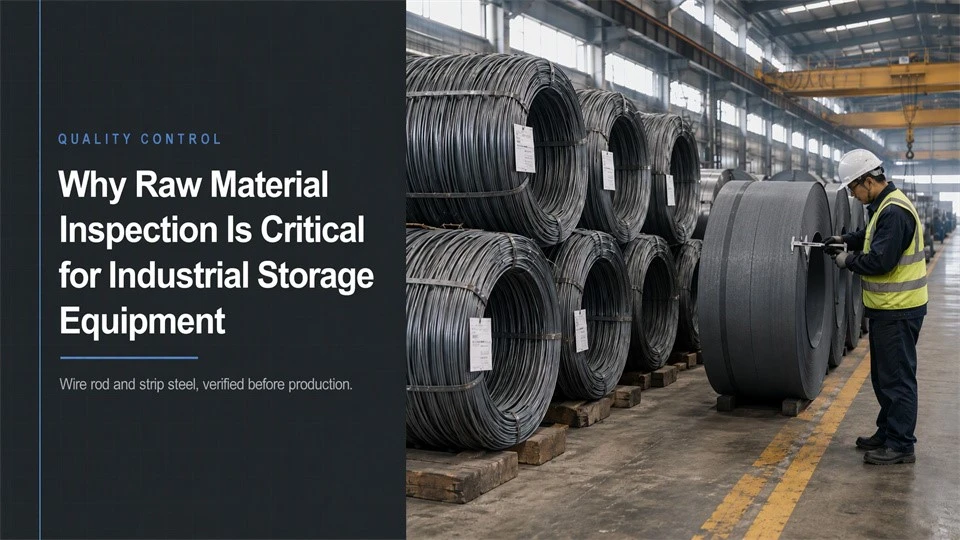
In heavy-duty warehousing, commercial distribution hubs, and industrial manufacturing plants, material handling equipment-such as post pallets, wire container cages, and steel stillages-must continuously bear substantial static and dynamic loads. The structural reliability of the finished product depends directly on the quality of incoming steel. Thorough raw material inspection is the vital first line of defense, ensuring that manufacturing begins on a verified structural foundation.
Verifying Dimensions to Prevent Structural Weakness
Raw steel profiles, tubes, and wire rods delivered from rolling mills often carry minor dimensional variances. Conducting baseline checks on outer pipe diameters, profile widths, and wall thicknesses confirms that incoming materials match structural design requirements. In heavy storage systems, a minor deficit in tube wall thickness significantly lowers overall column load capacity. Catching undersized steel tubing at the receiving stage prevents buckling risks when loaded racks are stacked multi-tiers high across busy logistics facilities.
Securing Flawless Welding and Assembly Integrity
The surface condition of raw steel dictates the strength of welded joints. Steel tubes and plates with heavy scale, oil contamination, or deep laminations can cause weld porosity, lack of fusion, or premature cracking under dynamic forklift handling. Inspecting incoming steel batches for surface cleanliness and uniform geometry ensures that guided welding fixtures achieve deep, consistent penetration. Sound welded connections allow structural bases and detachable posts to transfer total loads safely into the floor slab.
Ensuring Superior Coating Adhesion and Corrosion Protection
Warehouse environments often face seasonal humidity shifts and temperature fluctuations. Whether equipment receives hot-dip galvanizing, zinc plating, or thermal powder coating, the longevity of the finish relies heavily on the surface condition of the base metal. Thorough incoming inspection identifies severe surface oxidation and pitting before processing, ensuring optimal coating bonding and preventing early corrosion creep during long-term storage.
Eliminating Production Downtime and Waste
Detecting defective steel at the factory gate is far more cost-effective than catching structural flaws during final assembly or after delivery. By rejecting non-conforming batches immediately, manufacturers eliminate wasted labor, prevent line stoppages, and guarantee on-time shipping schedules for large-scale B2B supply chain contracts.
Building Predictable Performance from the Start
At ESWIRES, incoming raw material quality control is never treated as a formality. By rigorously verifying raw steel dimensions and structural suitability before tube sawing begins, we ensure that every finished pallet rack and storage container delivers reliable, predictable performance throughout its working life.